Climate & Biodiversity Initiative
Since 2010, the BNP Paribas Foundation has been supporting research into climate change and biodiversity through its Climate & Biodiversity Initiative international philanthropy programme. The goal? Improving our knowledge of the interactions between climate and biodiversity and the disruption of the climate system, to assess the consequences for our environment and our societies. This enables all stakeholders involved to adapt their behaviour.
Tackling the climate challenge with biodiversity
Droughts, water stress, heat waves, an increase in extreme events, melting glaciers, rising sea levels, etc. The erosion of biodiversity is currently a major global concern. Natural ecosystems need to be better protected and preserved.
Climate change is also a major driver of biodiversity erosion – biodiversity being essential to the natural development of all the planet’s ecosystems. Therefore, these are undeniably two of the greatest environmental challenges of our time.
With this in mind, in 2019 the Foundation decided to rename its international philanthropic programme from “Climate Initiative” to “Climate & Biodiversity Initiative“, shifting the focus of the call for projects on supporting scientific research on climate and biodiversity.
Supporting scientific research on climate and biodiversity
As part of its commitment to the environment, since 2010, the BNP Paribas Foundation has been supporting research on climate and biodiversity by working with international research teams.
With a budget of €7 million over three years to fund and promote 11 projects, this programme is based on the organisation of a call for projects every three years. During this call for projects, a rigorous selection process led by leading figures in their field of research is put in place to select the boldest, most innovative projects with the greatest impact.
€7 M

over three years to fund and promote 11 projects*
*environmental research projects on Ocean and coastal ecosystems.
Its objective? To select research projects aimed at improving knowledge of the interactions between climate and biodiversity and their effects on our societies. It also encourages researchers to identify nature-based solutions to climate change and biodiversity loss.
2025 Goal: Ocean and Poles!
In the light of the Climate & Biodiversity Initiative 2025 Call for projects’ focus “Ocean and coastal ecosystems”, discover the researchers that lead the latest laureate scientific projects related to these topics:
2025 call for projects laureates
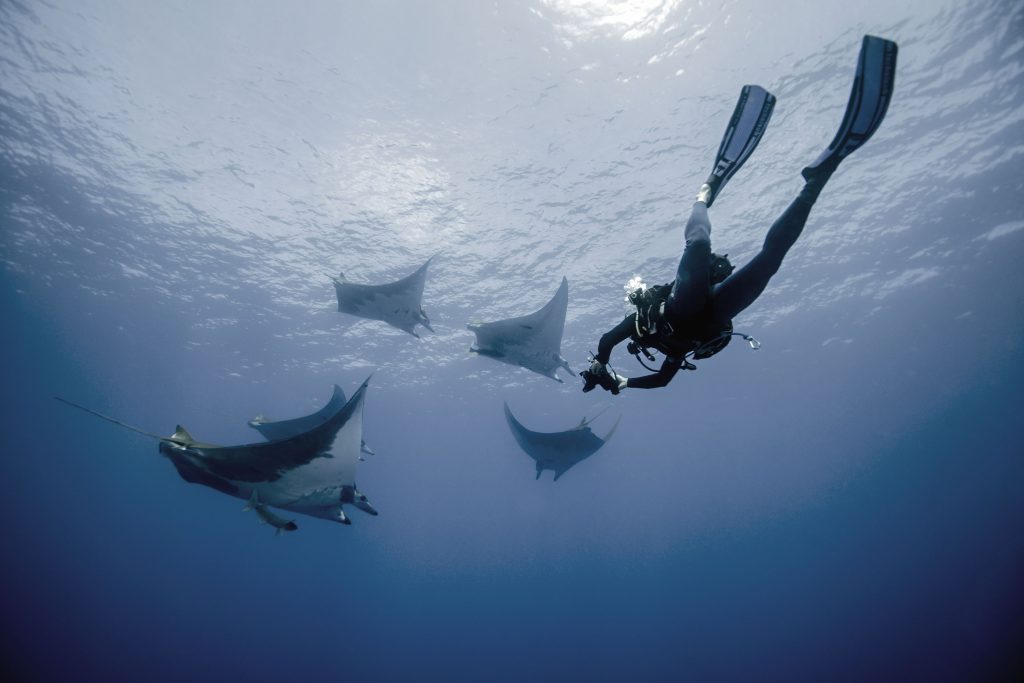
OCEANPATH
PROJECT MANAGER: Nuno Queiroz, PhD in biological sciences
PORTUGAL: SAFEGUARDING THE MIGRATION ROUTES OF MARINE MEGAFAUNA
IN THE GULF OF GUINEA
GENERAL CONTEXT
Global warming is predicted to cause ocean temperatures to rise between 1° and 6°C by 2100, causing major shifts in the movements of marine species. These species migrate horizontally towards the poles and vertically towards the depths to find suitable habitats. Tropical species, with low thermal tolerance, are particularly vulnerable. In parallel, ocean deoxygenation is decreasing dissolved oxygen levels, especially in tropical and subpolar regions. These changes are reducing viable habitats and increasing risks to marine megafauna. The Gulf of Guinea, an area of intensive illegal, unreported and unregulated fishing, accounts for around 25% of African maritime traffic, with approximately 1,500 vessels traversing it per day, increasing the risk of collisions with or accidental capture of large marine fauna.
Project objective
The project aims to define and establish an Atlantic Marine Migration Corridor (AMMC), a vast protected area on the high seas stretching from Cape Verde to the Gulf of Guinea and St Helena. It seeks to identify the 3D habitat use and migration routes of whale sharks, mako sharks and blue sharks and assess the impact of climate change and human pressures on these species.
ABYSCAPES
PROJECT MANAGER: Erik Simón-Lledó, senior researcher, Functioning and Vulnerability of Marine Ecosystems research unit
SPAIN: RESILIENCE TO CLIMATE CHANGE OF BIODIVERSITY IN DEEP-SEA ENVIRONMENTS
GENERAL CONTEXT
Deep-sea environments, the largest and leastknown ecosystems, are threatened by both climate change and seabed mining. AbyScapes aims to increase knowledge about biodiversity in the depths, combining imaging, genomics and predictive modelling to understand the mechanisms that shape life in the deep sea in order to better determine conservation strategies.
Project objective
By identifying large-scale deep-sea biodiversity patterns, AbyScapes will determine how these relationships evolve in a context of climate change and human impacts. To this end, the project aims to create the first integrated database with environmental, taxonomic, genetic and functional data on deep-sea biodiversity in the northeast Pacific.
MED-GUARD
PROJECT MANAGER: Virginie Sanial, senior lecturer in biological sciences
at the University of Toulon and the Mediterranean Institute of Oceanography
FRANCE: ADAPTATION AND RESILIENCE OF MEDITERRANEAN GROUNDWATER TO CLIMATE DISRUPTIONS
GENERAL CONTEXT
The Mediterranean Sea is warming 20% faster than the global average and is particularly vulnerable to climate change. Coastal groundwater, which is essential for the supply of fresh water and nutrients, is threatened by sea level rise and salinisation. These changes are likely to alter the input of nutrients and contaminants into marine ecosystems via underground discharges, with major consequences for biodiversity and water quality.
Project objective
MED-GUARD aims to assess the impact of climate change on subterranean estuaries, their microbial biodiversity and their ecological functions. This project will quantify groundwater flows
to the ocean, assess the effects of climate change on these flows, and determine how microbial communities contribute to filtration and bioremediation functions in these environments.
FISHMIP-OSP
PROJECT MANAGER: Olivier Maury, research director, French National Research
Institute for Sustainable Development (IRD), Marine Biodiversity, Exploitation and
FRANCE: OCEAN SYSTEM PATHWAYS: A NEW FRAMEWORK OF SCENARIOS AND SIMULATIONS TO STUDY THE FUTURE OF MARINE ECOSYSTEMS AND GLOBAL FISHERIES
GENERAL CONTEXT
Marine biodiversity is under increasing pressure from climate change and overfishing. Projections predict a 15–25% decline in global fish biomass by 2100, and up to 50% in tropical regions. These changes threaten food security, particularly in the global south, where
fish are an essential source of protein. Climate change risks exacerbating existing inequalities in terms of access to marine resources.
Project objective
After 10 years of studying the impact of climate change on marine life, the FishMIP-OSP project aims to simulate the future of marine ecosystems and fisheries by integrating climate and
socioeconomic scenarios. It will produce ensemble projections using the Ocean System Pathways (OSP) framework, which extends IPCC scenarios by taking into account the socioeconomic factors of fishing.
YOKHOSS
PROJECT MANAGER: Maria Darias, research director, French National Research Institute for Sustainable Development (IRD)
FRANCE: TOWARDS SUSTAINABLE OYSTER HARVESTING AND AQUACULTURE IN SENEGAL – DIVERSITY, CLIMATE RESILIENCE, NUTRITIONAL VALUE AND HEALTH
GENERAL CONTEXT
Senegal’s coastal ecosystems, particularly the Sine– Saloum and Casamance estuaries, face increasing environmental pressures: salinisation, temperature fluctuations, pollution, overfishing and global warming. Oysters such as Crassostrea tulipa play a vital role
in food security, livelihoods and ecosystem services. However, their genetic diversity, stress tolerance and nutritional value remain poorly studied.
Project objective
Transdisciplinary and interdisciplinary, with the close involvement of local communities, YOKHOSS aims to generate scientific knowledge to support the harvesting and sustainable aquaculture of climate-resilient oysters with nutritional value in Senegal.
CORALRESIST
PROJECT MANAGER: Serge Planes, research director, French National Centre for Scientific Research (CNRS), Centre for Island Research and Environmental Observatory (CRIOBE)
FRANCE: UNDERSTANDING THE UNDERLYING FACTORS IN CORAL REEF RESISTANCE TO GLOBAL WARMING
GENERAL CONTEXT
While global warming is causing massive coral bleaching events worldwide, the reefs of the Coral Triangle in East Asia are showing remarkable resilience. The CORALRESIST project aims to understand the biological, ecological and evolutionary mechanisms behind this resistance, building on the findings of the Tara Pacific expedition (2016–2018).
Project objective
The main objective is to elucidate the factors that make corals in the Coral Triangle resistant to heat. The project combines multiomic approaches (genomics, transcriptomics, metabolomics),
in-situ heat stress tests, microbiome analyses and palaeoclimate reconstructions.
MICRO-ARCTIC
PROJECT MANAGER: Pierre Galand, research director, French National Centre for Scientific Research, Benthic Ecogeochemistry Laboratory (LECOB), Banyuls Oceanographic Observatory
FRANCE: MICROBIAL LIFE IN A CHANGING ARCTIC OCEAN
GENERAL CONTEXT
The Arctic is warming four times faster than the global average, leading to rapid sea ice loss and
major disruptions to ocean and atmospheric conditions. These changes threaten the Arctic microbiome – microorganisms that regulate nutrient cycles and climate feedbacks – whose resilience and connectivity between the ocean, the ice and the atmosphere remain poorly understood.
Project objective
MICRO-ARCTIC aims to explore the diversity, connectivity and adaptation mechanisms of the Arctic Ocean microbiome in the ocean, sea ice and atmosphere. Using the drifting Tara Polar
Station, the project will collect data throughout the year to understand how the microbiome responds to extreme seasonal changes and climate stress.
PHYTOSCOPE
PROJECT MANAGER: Roy El Hourany, associate professor, Oceanography and Geosciences Labor
FRANCE: PHYTOPLANKTON BIODIVERSITY IN AN OCEAN IN TRANSITION – INTEGRATING REMOTE SENSING, MODELLING AND THEORY TO PREDICT CLIMATE-RELATED CHANGES
GENERAL CONTEXT
Phytoplankton, although microscopic, accounts for nearly 50% of terrestrial primary oxygen production and plays a central role in the carbon cycle. While climate change is altering phytoplankton diversity and distribution, with cascading effects on marine
ecosystems, global biodiversity patterns and future responses remain poorly understood. PHYTOSCOPE seeks to fill this gap by integrating satellite and in-situ data, biogeochemical modelling and scientific theory to anticipate future changes in marine biodiversity.
Project objective
PHYTOSCOPE aims to detect past and present changes in phytoplankton biodiversity and to forecast future changes under different climate scenarios. It will combine high-resolution
remote sensing, in-situ validation, biogeochemical modelling (NEMO-PISCES models) and ecological theory (METAL framework).
SHOW-IT
PROJECT MANAGER: Ana Verissimo, PhD in marine sciences, assistant researcher at BIOPOLIS
PORTUGAL: ASSESSMENT OF THE EFFECTS OF CLIMATE CHANGE ON THE EARLY STAGES OF THE BIOLOGICAL CYCLE OF PREDATORS
GENERAL CONTEXT
The oceans have absorbed 90% of recent global warming, causing rising sea temperatures and marine heatwaves that are threatening biodiversity. Elasmobranchs (sharks and rays), key predators in marine ecosystems, are particularly vulnerable. Their early life stages, particularly in oviparous species such as the small-spotted catshark, depend on stable thermal conditions in nurseries. Global warming could disrupt their embryonic development, immune system maturation, microbial colonisation, and brain structure, with cascading effects on their survival and behaviour.
Project objective
This interdisciplinary project aims to assess how warming during development affects embryogenesis, immune and nervous system development, microbiome diversity, and juvenile behaviour in two genetically distinct populations of the small-spotted catshark (Scyliorhinus canicula).
MARINE MICROSWIMMERS
PROJECT MANAGER: Nicolas Garcia Seyda, postdoctoral researcher, the French National Research Institute for Sustainable Development (IRD), Entropie research unit
FRANCE: MARINE MICROSWIMMERS
GENERAL CONTEXT
Benthic marine organisms such as corals, spongesand seagrass beds play a key role in ecosystem functioning, biodiversity and resilience to climate change.
Fragilised by marine heatwaves, they may benefit from the support of mobile microorganisms (e.g. bacteria, microalgae) capable of improving their resistance. The
project aims to study these interactions in order to develop nature-based solutions.
Project objective
The MARINE MICROSWIMMERS project aims to understand how mobile marine microorganisms interact with benthic species (corals, sponges, gorgonians, seagrass beds) to reinforce their
resilience to climate change.
SUPERCOR-AI
PROJECT MANAGER: Emilie Boissin, postdoctoral researcher, Centre for Island Research and Environmental Observatory (CRIOBE)
FRANCE: UNDERSTANDING CORAL RESILIENCE TO SUPPORT APPLIED REEF RESTORATION, MONITORED BY AI
GENERAL CONTEXT
If current trends continue, 90% of the world’s coral reefs could disappear by 2030. Reunion Island, where around 5% of corals are naturally resistant, offers an ideal environment for developing an innovative and sustainable method of active restoration that could be easily adapted on a large scale.
Project objective
The SUPERCOR-AI project will use cutting-edge technology to analyse the urgent question of the resilience of reefs. By exploiting advances in genomics, scientists can better understand
corals and their microbiome. This project plans to use genomic and microbiomic data to enable the assessment of coral resistance and resilience.
In 2023, 8 new international research projects joined the programme. Some of the winning research projects, for example, are looking at ocean acidification, how forests – whether plant or animal forests! – capture and store carbon, or the resistance of fruit trees to climate change.
- COAST-VOC (Finland)
- PHYTOPLANCTON (CNRS, France)
- DEEPLIFE (Paris, France)
- FRUIT RESCUE (CNRS, France)
- FUTURE FEAR (CNRS, France)
- FLOCHAR (Germany)
- NATURAL FORESTORE (France)
- REFUGE ARCTIC (CNRS, France)
Further support for research
As a result of its long-standing common history with the Fondation pour la Recherche Médicale (FRM), the BNP Paribas Foundation has decided to renew this partnership through the 2020 edition of the FRM’s “Environment & Health” call for projects.
Until 2024, we supported the research projects of researcher Karine Adel-Patient on the links between perinatal nutrition and childhood allergies, and researcher Ouria Dkhissi-Benyahya on the consequences of abnormal light exposure for teenagers.
Fondation pour la Recherche Médicale (FRM): French foundation supporting and financing public research in all areas in the fields of medicine and pathophysiology.
2025 Call for Projects


The selection process


The latest news